











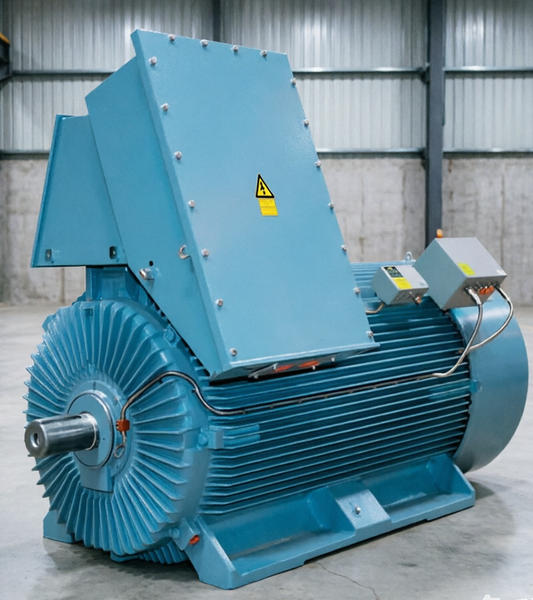
Advantage and Application of Squirrel Cage Induction Motor
A three‑phase squirrel cage induction motor operates based on electromagnetic induction principle. It gets the name “squirrel‑cage” from its special rotor structure, namely squirrel cage rotor, whose conductive bars and short‑circuit end‑rings form a closed loop visually similar to a squirrel cage.
When three‑phase alternating current feeds into stator windings, a rotating magnetic field rotating at synchronous speed is produced. This magnetic field cuts the conductive bars of the squirrel cage rotor and induces short‑circuit current inside rotor bars. The induced rotor current generates an independent rotor magnetic field. Mutual interaction between stator magnetic field and rotor magnetic field creates electromagnetic torque, which drives the rotor to rotate and output mechanical power.
There always exists slight speed difference between actual rotor speed and synchronous speed. If rotor revolved exactly at synchronous speed, there would be no relative motion between rotating magnetic field and rotor conductors; no current would be induced in rotor bars and torque would disappear. For this reason, the rotor runs persistently at a speed slightly lower than synchronous speed.
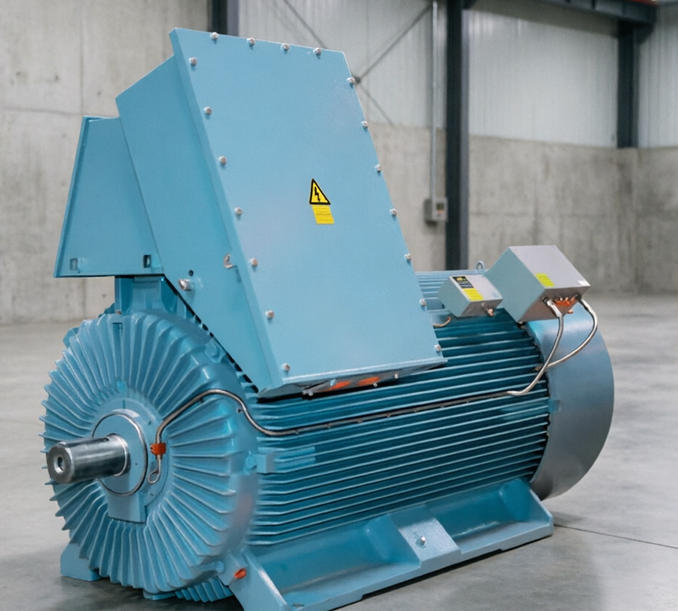
Main Structure of Squirrel Cage Induction Motor
- Stator
Composed of laminated iron core, 120°‑spaced three‑phase windings and protective metal casing. Laminated core offers low‑reluctance passage for magnetic flux from alternating‑current windings. - Squirrel Cage Rotor
Built with laminated iron core, rotating shaft, short‑circuited aluminum or copper bars and two end rings. Rotor bars are skewed to avoid cogging phenomenon at startup and optimize stator‑rotor voltage ratio. Laminated core suppresses energy loss caused by eddy current and hysteresis effect. - Cooling Fan
Mounted on rear end of rotor shaft. It realizes forced air cooling, dissipates operating heat and stabilizes motor working temperature. - Bearings
Support rotor shaft and guarantee smooth, low‑friction rotation of the whole rotor assembly.
Industrial Applications
Thanks to self‑starting capability, stable constant‑speed performance and low‑maintenance property, squirrel cage induction motors are widely deployed across industrial sectors:
‑ Centrifugal pumps
‑ Conveyor belts and material‑handling industrial drives
‑ Large‑capacity blowers and fans
‑ Various machine tools
‑ Lathes and turning processing equipment
‑ Compressors, mining and cement production facilities
‑ Auxiliary equipment for power generation
Advantage of Squirrel Cage Induction Motor
- Cost‑effective: Simple manufacturing structure brings relatively low procurement cost.
- Low‑maintenance design: Free of slip rings and carbon brushes; fewer wearing components reduce routine upkeep workload.
- Stable speed performance: Excellent speed regulation to keep nearly constant rotational speed under normal load.
- High operating efficiency: Achieve high energy‑conversion efficiency from electric power to mechanical power in continuous running condition.
- Superior thermal performance: Good thermal regulation keeps motor working temperature at a reasonable level.
- Compact & light‑weight: Small footprint and light weight for convenient installation and layout.
- Intrinsic explosion‑proof safety: No spark‑generating brushes, eliminating spark hazard for hazardous working environments.
Disadvantages of Squirrel Cage Induction Motor
- Limited starting torque and relatively large starting current at power‑on.
- Difficult to carry out smooth, wide‑range speed regulation without extra variable‑frequency drives.
- Lower efficiency during startup phase compared with rated‑speed operation.
- Sensitive to voltage fluctuation; output torque drops sharply when supply voltage decreases.
Related Posts

NORD UNIVERSAL SMI Worm Gearmotor (Low Voltage)
Jua 27, 2026
NORD MAXXDRIVE® Parallel Gear Unit (Standard Model)
Jua 26, 2026
SIEMENS Industrial Low-Voltage Helical Gearmotor
Jua 26, 2026