











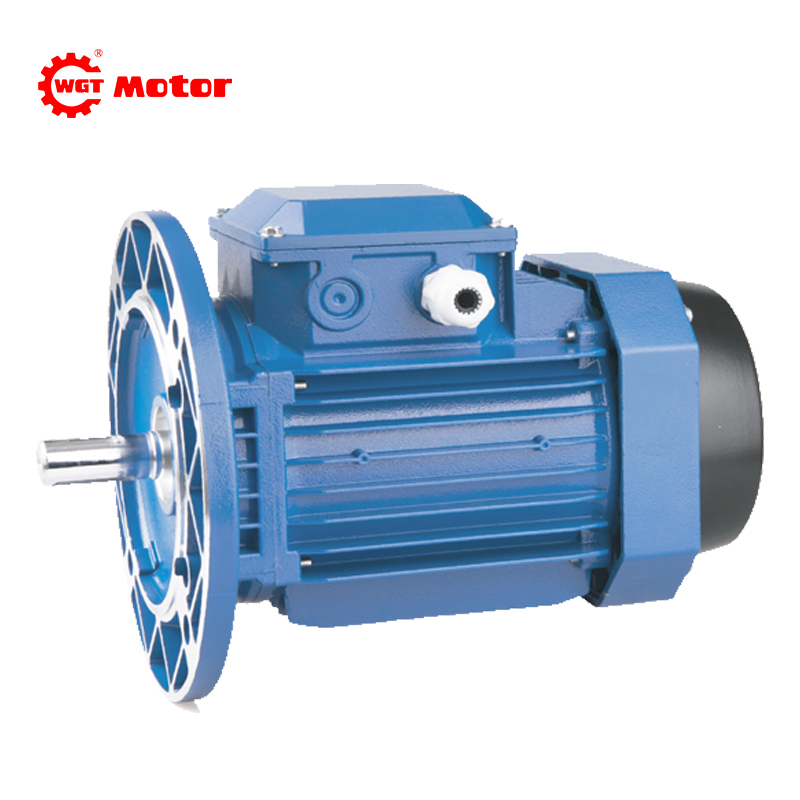
Advantages of the Squirrel Cage Induction Motor
A three-phase squirrel cage induction motor is a type of three-phase induction motor that operates on the principle of electromagnetic induction. It is called a squirrel cage motor because its rotor — known as a squirrel cage rotor — resembles the running wheel of a squirrel cage.
When the stator is energized, a rotating magnetic field is produced. This field induces a current in the rotor conductors, which in turn creates its own magnetic field. The interaction between the magnetic fields of the stator and the rotor produces torque, causing the rotor to rotate.
Principle of Operation
When a three-phase supply is connected to the stator winding, it creates a rotating magnetic field in space. The speed of this field is called the synchronous speed.
This rotating magnetic field cuts the rotor bars and induces a voltage in them. Since the rotor bars are short-circuited, current begins to flow through them. These rotor currents produce their own magnetic field, which interacts with the stator’s magnetic field.
The rotor magnetic field tries to oppose the cause that produced it, so the rotor starts to follow the rotating magnetic field. However, the rotor can never reach the synchronous speed. If it did, there would be no relative motion between the rotor and the rotating magnetic field, and no voltage would be induced in the rotor bars. As a result, the rotor current would become zero, and the torque would disappear.
Because of this, the rotor always runs at a speed slightly lower than the synchronous speed. This difference in speed is called slip, and it is necessary for the motor to continue producing torque.
Motor Structure
The squirrel cage induction motor mainly consists of the following parts:
Stator
The stator is the stationary part of the motor. It consists of a three-phase winding mounted on a laminated iron core and enclosed in a metal frame. The three-phase windings are placed 120° apart electrically and mechanically. The laminated iron core provides a low-reluctance path for the magnetic flux produced by the AC supply.
Rotor
The rotor is the rotating part of the motor. It converts electrical energy into mechanical energy and delivers output through the motor shaft. The rotor consists of a shaft, a laminated core, and short-circuited copper or aluminum bars.
Squirrel Cage Rotor
The rotor core is made of laminated steel to reduce power losses caused by eddy currents and hysteresis. The rotor conductors are slightly skewed to prevent cogging during starting and to ensure smoother operation.
Fan
A cooling fan is mounted on the rear end of the rotor. It helps dissipate heat and keeps the motor temperature within a safe operating range.
Bearings
Bearings support the rotor shaft and allow it to rotate smoothly with minimum friction.
Applications
Squirrel cage induction motors are widely used in industrial and commercial applications. They are especially suitable for applications that require constant speed, self-starting capability, and low maintenance.
Common applications include:
- Centrifugal pumps
- Industrial drives, such as conveyor belts
- Large blowers and fans
- Machine tools
- Lathes and other rotating equipment
- High-voltage water pumps and large fan drives
Advantages of Squirrel Cage Induction Motors
Squirrel cage induction motors are popular because of their simple construction and reliable performance. Their main advantages include:
- Low cost – They are economical to manufacture and purchase.
- Low maintenance – They do not have slip rings or brushes, so maintenance requirements are minimal.
- Good speed regulation – They can maintain nearly constant speed under normal operating conditions.
- High running efficiency – They convert electrical energy into mechanical energy efficiently during normal operation.
- Better thermal performance – They generally run cooler due to effective heat dissipation.
- Compact and lightweight – Their simple design makes them smaller and lighter than many other motor types.
- Explosion-proof operation – Since there are no brushes, the risk of sparking is greatly reduced, making them safer in hazardous environments.
Conclusion
The squirrel cage induction motor is one of the most widely used electric motors in industry. Its simple and rugged construction, low maintenance, good efficiency, and reliable performance make it an excellent choice for most constant-speed applications.
Related Posts

NORD UNIVERSAL SMI Worm Gearmotor (Low Voltage)
Jua 27, 2026
NORD MAXXDRIVE® Parallel Gear Unit (Standard Model)
Jua 26, 2026
SIEMENS Industrial Low-Voltage Helical Gearmotor
Jua 26, 2026