











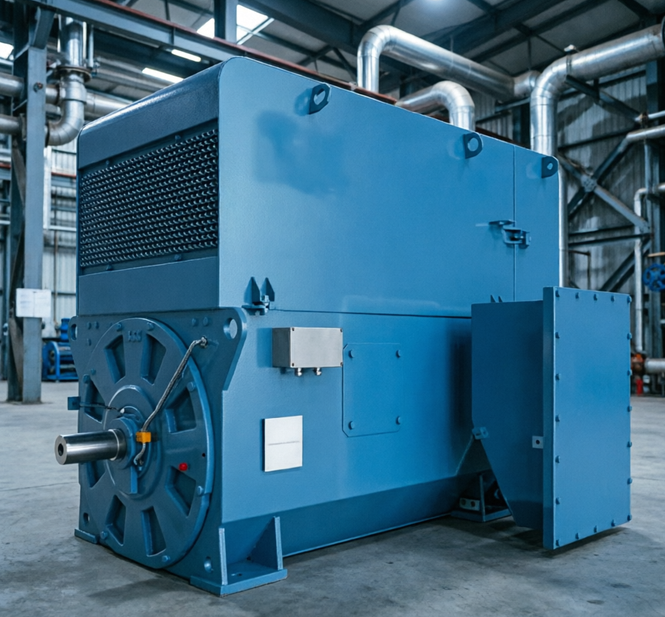
Understanding Asynchronous Motors: Construction and How Asynchronous Motors Work
In the world of electrical equipment, we often encounter various types of motors, including synchronous and asynchronous motors. Asynchronous motors are renowned for being tough, reliable, and versatile. As the name implies, these motors are defined by the fact that the rotor runs asynchronously—at a different speed—compared to the rotating electromagnetic field generated by the stator.
What is an Asynchronous Motor?
Definition: Asynchronous motors, also known as induction motors, are alternating current (AC) motors. The core principle involves the induction of current inside the rotor by the rotating magnetic field of the stator.
In this motor layout, the rotor's motion is never perfectly synchronized with the stator's magnetic field. Instead, the rotating stator magnetic field induces a magnetic field in the rotor winding. This induced current generates the necessary force (torque) to turn the rotor. Because the rotor speed cannot match the stator field speed exactly, torque is continuously generated.
These are the most typical electric motors found in the market. Three-phase asynchronous motors are cost-effective, easy to maintain, and offer excellent performance compared to single-phase motors. A key characteristic of these motors is that their speed is generally fixed by the frequency of the power supply and is not easily varied without specific drives.
Construction of an Asynchronous Motor
Unlike some other motor types, the asynchronous motor does not typically use permanent magnets. Instead, it relies on electromagnetic induction.
- Stator: The stationary part contains coils connected to a power source (single-phase or three-phase) to create a rotating electromagnetic field.
- Rotor: The rotating part does not receive electrical energy through direct conduction (like brushes in a DC motor). Instead, the current in the rotor is activated by an induced voltage from the stator's steering field.
- Basically, the rotor's electromagnetic field "chases" the stator's magnetic field but never catches up. This difference in speed is technically referred to as slip.
How Asynchronous Motors Work
To understand how asynchronous motors work, we must look at the concept of electromagnetic induction.
- Induction: The rotor does not receive external electrical stimulation. Instead, the variable electromagnetic field from the stator induces a current in the rotor.
- Rotation: This induced current creates a magnetic field in the rotor, which interacts with the stator's field to produce torque.
- Slip: The rotor rotates at a speed slightly lower than the synchronous speed of the stator's magnetic field. If the rotor were to spin at the exact same speed, there would be no relative motion, no induced current, and therefore no torque.
- Therefore, the motor is called "asynchronous" because the rotor speed and the magnetic field speed are not the same. This velocity difference is essential for the motor's operation and is called slipping.
Related Posts

NORD UNIVERSAL SMI Worm Gearmotor (Low Voltage)
Jua 27, 2026
NORD MAXXDRIVE® Parallel Gear Unit (Standard Model)
Jua 26, 2026
SIEMENS Industrial Low-Voltage Helical Gearmotor
Jua 26, 2026