











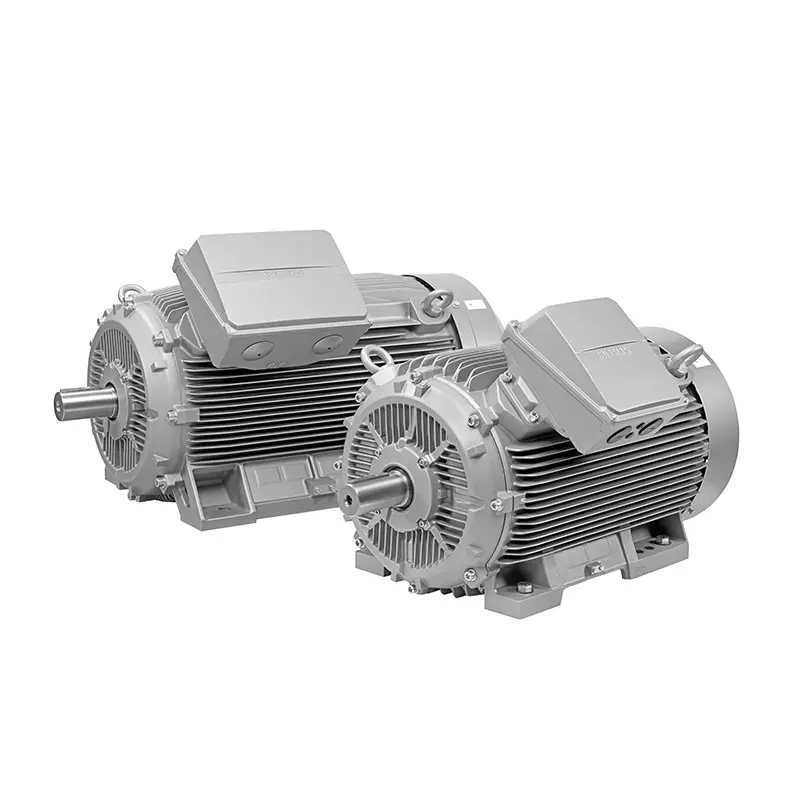
Synchronous Motor vs Induction Motor: Key Facts to Understand
When selecting an AC motor for an application, understanding the fundamental differences between synchronous and induction motors is essential. While both convert electrical energy into mechanical energy using alternating current, their operating principles, performance characteristics, and ideal use cases differ significantly.
Operating Principles: The Core Difference
The most defining distinction between these two motors lies in their speed relative to the supply frequency:
- Induction Motors (Asynchronous): These motors operate on the principle of electromagnetic induction. When AC power is applied to the stator, it creates a rotating magnetic field (RMF). This RMF induces a current in the rotor, which in turn creates its own magnetic field. The interaction between these fields produces torque. Crucially, the rotor must rotate slightly slower than the RMF to maintain this induction. This speed difference is known as "slip." Because of slip, the rotor's speed is asynchronous to the supply frequency.
- Synchronous Motors: As the name implies, these motors operate in perfect synchronization with the supply frequency. The rotor's magnetic field locks onto the stator's RMF, causing the rotor to spin at the exact same speed (synchronous speed). There is no slip in a synchronous motor. The rotor's magnetic field is typically created using permanent magnets or a DC-excited winding.
Key Performance Characteristics
| Feature | Induction Motor | Synchronous Motor |
|---|---|---|
| Speed | Runs slightly below synchronous speed due to slip. Speed varies with load. | Runs at a constant synchronous speed, regardless of load. |
| Starting | Self-starting. Can begin rotating from a standstill simply by applying power. | Not self-starting. Requires an auxiliary starting mechanism or variable frequency drive (VFD) to bring it up to synchronous speed. |
| Power Factor | Always operates at a lagging power factor, which varies with load. | Power factor can be adjusted (leading, lagging, or unity) by controlling the rotor's DC excitation. |
| Efficiency | Generally high, but slightly lower due to energy losses from slip. | Typically more efficient, especially at full load, because there are no slip-related losses. |
| Complexity & Cost | Simple, rugged, and inexpensive to manufacture and maintain. | More complex due to the excitation system and rotor construction, leading to higher initial and maintenance costs. |
| Power Density | Lower power-to-size ratio. | Higher power density, delivering more power in a smaller frame size. |
Applications: Choosing the Right Tool for the Job
The distinct characteristics of each motor type make them suitable for different applications:
Induction Motors: The Workhorses of Industry
Thanks to their simplicity, robustness, low cost, and self-starting capability, induction motors are the most widely used motors in the world. They are ideal for applications where precise speed control is not critical and the load may vary.
- Industrial: Pumps, fans, compressors, conveyors, and machine tools.
- Commercial & Residential: Washing machines, refrigerators, air conditioners, and household fans.
- Automotive: Often used as secondary motors in electric vehicles (e.g., for the front axle in some AWD systems) due to their high-speed capabilities and lack of permanent magnets.
Synchronous Motors: Precision and Efficiency
Synchronous motors are chosen when constant speed, high efficiency, or power factor correction is paramount, justifying their higher cost and complexity.
- Precision Timing & Control: Clocks, timers, tape recorders, robotics, and CNC machines where exact speed is critical.
- High-Power Industrial Drives: Crushers, rolling mills, grinders, and large compressors where high efficiency and constant speed under heavy load are required.
- Power Factor Correction: Large synchronous motors can be over-excited to operate at a leading power factor, acting like a capacitor to improve the overall power factor of an industrial plant's electrical system.
- Automotive: Permanent Magnet Synchronous Motors (PMSMs) are the dominant choice for the main traction motor in most modern electric vehicles, prized for their high power density, efficiency, and strong low-speed torque.
Conclusion: Making the Right Choice
The choice between a synchronous and an induction motor ultimately comes down to a trade-off between cost/complexity and performance/precision.
- Choose an induction motor if your application demands a rugged, low-cost, and low-maintenance solution for general-purpose driving with variable loads.
- Choose a synchronous motor if your application requires precise speed control, high efficiency at full load, high power density, or the ability to correct power factor, and you are willing to accept a higher initial investment and more complex control systems.
Related Posts

NORD UNIVERSAL SMI Worm Gearmotor (Low Voltage)
Jua 27, 2026
NORD MAXXDRIVE® Parallel Gear Unit (Standard Model)
Jua 26, 2026
SIEMENS Industrial Low-Voltage Helical Gearmotor
Jua 26, 2026