











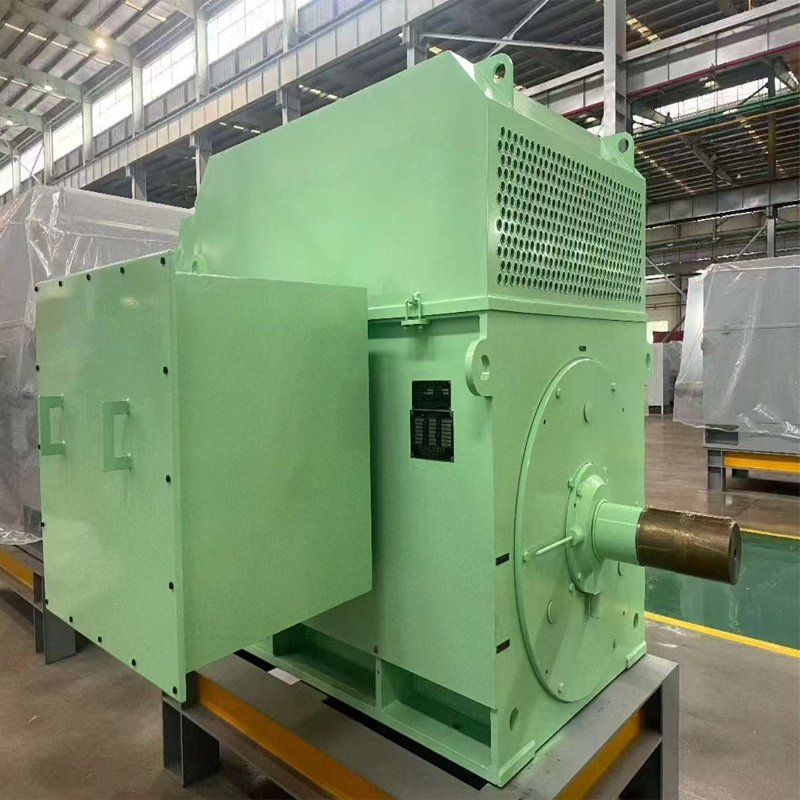
Synchronous vs Induction Motor: Which One Should You Choose?
When selecting an AC motor for any application, one of the most critical decisions is choosing between a synchronous motor and an induction motor. Both belong to the AC motor family, yet they operate on fundamentally different principles, offer distinct performance characteristics, and serve different purposes. This article breaks down the key differences to help you make an informed choice.
How They Work
Induction Motors
Induction motors are among the most widely used motors in industry today. Their design is elegantly simple: an external stator and an internal rotor work together through the principle of electromagnetic induction.
When alternating current flows through the stator coils, it generates a rotating magnetic field (RMF). This RMF induces a current — and consequently an opposing magnetic field — in the rotor. The interaction between these two fields produces mechanical rotation. Because the rotor always lags slightly behind the RMF, a phenomenon known as "slip" occurs. This slip is what allows the rotor to continuously "chase" the rotating field, but it also means the output shaft speed never perfectly matches the supply frequency.
Note: Induction motors are sometimes referred to as asynchronous motors precisely because of this slip.
Synchronous Motors
Synchronous motors take a different approach. Instead of relying on induction, they physically lock the magnetic poles of the rotor to the stator's RMF. This means the rotor rotates at a speed that is precisely synchronized with the frequency of the AC supply — hence the name.
Because there is no slip, the output rotational frequency is an exact match to the input frequency. This makes synchronous motors ideal for applications that demand precise timing and constant speed, such as clocks, record players, and rolling mills.
However, this precision comes with a trade-off: synchronous motors are not inherently self-starting. They typically require a motor starter or auxiliary mechanism to bring the rotor up to near-synchronous speed before the magnetic lock can engage.
Key Differences at a Glance
| Feature | Induction Motor | Synchronous Motor |
|---|---|---|
| Operating Principle | Electromagnetic induction with slip | Direct magnetic locking, no slip |
| Speed Accuracy | Slightly below synchronous speed | Exactly matches supply frequency |
| Self-Starting | Yes — starts from standstill | No — requires a starter |
| Speed Control | Relatively straightforward | Requires an AC motor controller |
| Efficiency | Good, but slip causes energy loss | Often >90%, no slip losses |
| Power Density | Lower | Higher — more power in less volume |
| Complexity | Simple design, easy to maintain | Complex rotor, more circuitry needed |
| Cost | Lower initial and maintenance cost | Higher initial and maintenance cost |
When to Choose Which?
Choose an Induction Motor When:
- Simplicity and cost are top priorities. Induction motors are inexpensive to manufacture, operate, and maintain.
- You need a self-starting motor without additional peripherals.
- The application does not demand exact speed synchronization — household appliances, electric vehicles, fans, pumps, and general industrial machinery are all well-suited.
- You want a proven, time-tested technology with a vast range of available speeds, torques, voltages, and form factors.
Choose a Synchronous Motor When:
- Precision timing is essential — think clocks, positioning systems, and timing-critical industrial processes.
- You need high efficiency and want to minimize energy losses from slip.
- Space is limited — synchronous motors deliver more power per unit of volume.
- The application involves low-speed, high-power operations such as crushers, mills, and grinders, where synchronous motors truly excel.
- You are willing to invest more upfront, knowing that long-term energy savings and power factor correction capabilities may offset the higher initial cost.
The Bottom Line
The choice between synchronous and induction motors ultimately comes down to your application's specific requirements.
Induction motors win on simplicity, affordability, and ease of use. They are the workhorses of modern industry — reliable, self-starting, and available in countless configurations.
Synchronous motors win on precision, efficiency, and power density. They demand more investment and complexity but deliver superior performance where exact speed control and energy efficiency matter most.
When evaluating either option, always consider the total lifecycle cost — not just the purchase price, but also operating expenses, maintenance, energy consumption, and the specific demands of your application. The right motor is the one that delivers the best balance of performance and cost over its entire service life.
Related Posts

NORD UNIVERSAL SMI Worm Gearmotor (Low Voltage)
Jua 27, 2026
NORD MAXXDRIVE® Parallel Gear Unit (Standard Model)
Jua 26, 2026
SIEMENS Industrial Low-Voltage Helical Gearmotor
Jua 26, 2026