











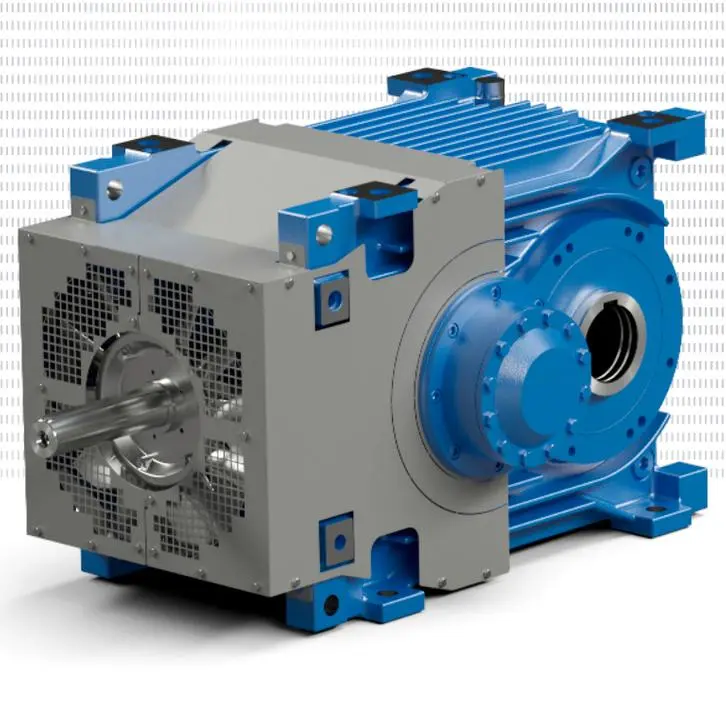
Synchronous vs Induction Motor: Which One Should You Choose?
How to Choose the Right Motor
The first step in selecting any motor is to determine its power supply — AC or DC. This narrows the options into two main categories and eliminates motors incompatible with your electrical supply. Since both categories contain many subtypes, this article focuses on differentiating the AC motor family: synchronous vs induction motor, covering their operating principles, characteristics, and applications.
Induction Motor
Induction motors are arguably the most widely used AC motors in industry today. As one of the earliest motor inventions, they have been extensively optimized for a broad range of applications. Their structure is relatively simple — an external stator and an internal rotor interact through electromagnetic induction to produce mechanical rotation.
In general, alternating current passes through the stator coils to generate a rotating magnetic field (RMF). This RMF then induces an opposing magnetic field in the rotor — a free-moving armature attached to the output shaft — driving useful rotation.
Synchronous Motor
Synchronous motors address the key limitation of induction motors: their "asynchronous" nature. In induction motors, the AC frequency does not directly match the output shaft's rotational frequency. This phenomenon, called slip, occurs because the rotor perpetually plays a magnetic game of "catch-up" with the RMF. Slip makes induction motors difficult to time with precision.
Synchronous motors, by contrast, match the output rotational frequency exactly to the input AC frequency. They achieve this by magnetically locking the stator and rotor poles together, so the stator RMF drives the rotor at a precisely synchronized speed. This makes them ideal for precision timing applications such as clocks, rolling mills, and record players.
However, synchronous motors are not inherently self-starting — they typically require a motor starter to excite the rotor to full speed. Additionally, changing their speed requires an AC motor controller. While generally more expensive than induction motors, they offer higher efficiency and are well-suited for crushers, mills, grinders, and other low-speed, high-power applications.
Synchronous vs Induction Motor: Key Differences
| Factor | Induction Motor | Synchronous Motor |
|---|---|---|
| Complexity | Simple to manufacture, operate, and maintain | More complex rotor design; requires additional circuitry |
| Self-Starting | Yes — starts directly from standstill | No — requires a motor starter |
| Power Density | Lower | Higher — delivers more power in a smaller volume |
| Efficiency | Good, but slip causes energy loss | Often >90% — no slip means less energy wasted |
| Speed Control | Relatively straightforward | Requires an AC motor controller |
| Cost | Lower initial, operating, and maintenance cost | Higher upfront cost, but energy savings and power factor correction may offset it over the lifecycle |
Summary
The choice between a synchronous vs induction motor ultimately depends on your application's priorities. If simplicity, low cost, and ease of maintenance are paramount, the induction motor is the go-to choice. If precision timing, higher efficiency, and greater power density are critical — and you're willing to invest in higher upfront costs — the synchronous motor is the better option. Always consider total lifecycle cost, not just the initial price tag, when making your decision.
Related Posts

NORD UNIVERSAL SMI Worm Gearmotor (Low Voltage)
Jua 27, 2026
NORD MAXXDRIVE® Parallel Gear Unit (Standard Model)
Jua 26, 2026
SIEMENS Industrial Low-Voltage Helical Gearmotor
Jua 26, 2026