











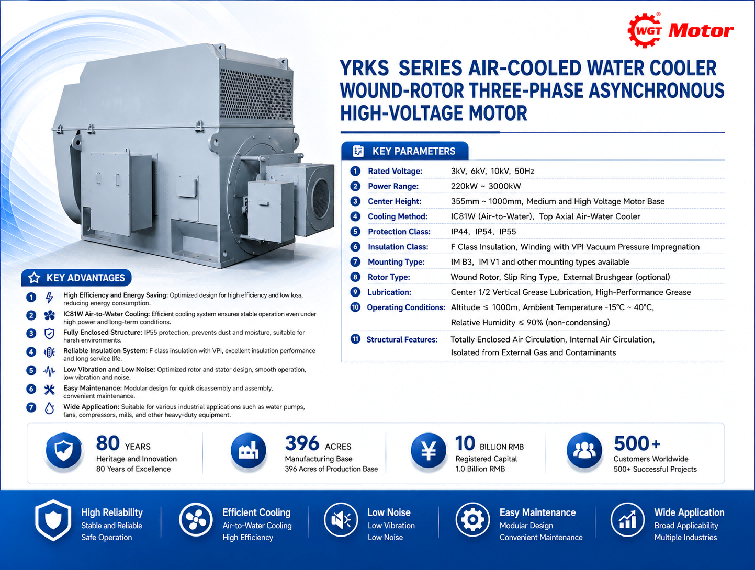
Advantages and Disadvantages of YRKS Series Three-Phase High-Voltage Motors with Air-to-Water Coolers Compared to Other Motors
Advantages & Disadvantages of YRKS Series High-Voltage Wound Rotor Induction Motors with Air-to-Water Cooler & Comparison with Other Types
1. Model Definition
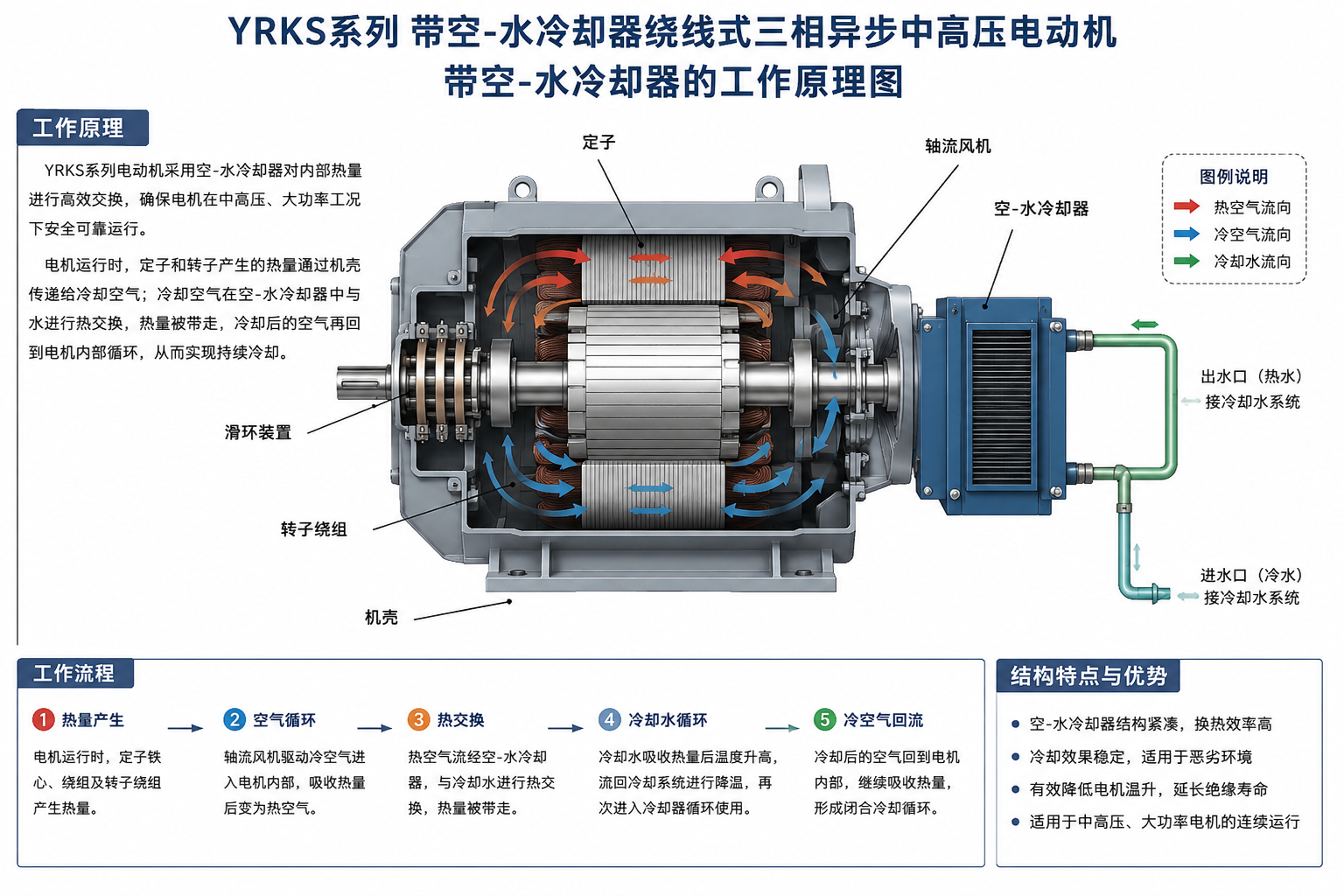
- YRKS: Wound rotor high-voltage motor, box-type enclosed structure, top-mounted air-to-water heat exchanger (cooling type IC81W, closed internal air circulation cooled by external cooling water).
- Comparable mainstream motor models:
2. Core Advantages of YRKS
(1) Electrical Merits Unique to Wound Rotor Design (Superior to YKS/YKK/Y squirrel-cage motors)
- Ultra-low starting current & high starting torque
External frequency-sensitive rheostat / liquid resistance can limit starting current to 1.21.5 times rated current, while direct-on-line squirrel-cage motors reach 57 times rated current. It delivers high torque under heavy startup conditions, avoiding grid voltage drop, tripping and mechanical impact on transmission equipment, ideal for sites with limited grid capacity and frequent heavy-load startup. - Smooth speed regulation capability
Speed can be adjusted in a wide low-speed range via series rotor resistance or cascade speed control without high-power inverters, cutting upfront investment for conveyors, hoists and rolling mills with variable intermittent loads. - Strong tolerance to heavy shock loads
Copper wound rotor withstands locked rotor and transient overload far better than cast aluminum squirrel cages, less prone to overheating under fluctuating heavy loads.
(2) Superior Heat Dissipation of Air-to-Water Cooling (vs air-cooled YRKK & open YR)
- Excellent heat exchange efficiency & low temperature rise
Water has a specific heat capacity 3,500 times that of air; cooling efficiency is 30%~50% higher than air-to-air YRKK. It supports higher power density within the same frame size with smaller footprint, perfectly suited for units above 800kW running 24/7 full load. - Fully sealed clean internal chamber, high protection class (IP44/IP54/IP55)
Totally enclosed internal air circulation blocks dust, moisture and corrosive gas from windings. Compared with IP23 open YR motors used in mines, metallurgy and chemical plants, insulation service life doubles with rare dust-caused short circuits. - Lower operating noise
No large external axial cooling fan; silent water heat exchange reduces noise by 8~15dB versus YRKK air-cooled motors, compliant with strict noise control standards for indoor workshops. - Wider environmental adaptability
Stable temperature control in high-temperature workshops, enclosed heat-trapping machine rooms and altitudes over 1,000m where air-cooled motors must derate output due to heat dissipation degradation.
(3) Robust Structure & Extended Service Life
Welded steel box frame with Class F VPI vacuum impregnated insulation, anti-moisture and thermal shock resistant. Rolling / sliding bearings with on-running grease injection available for long-term continuous stable operation. Low winding temperature rise slows insulation aging, extending overhaul cycle by 30% vs air-cooled wound rotor equivalents.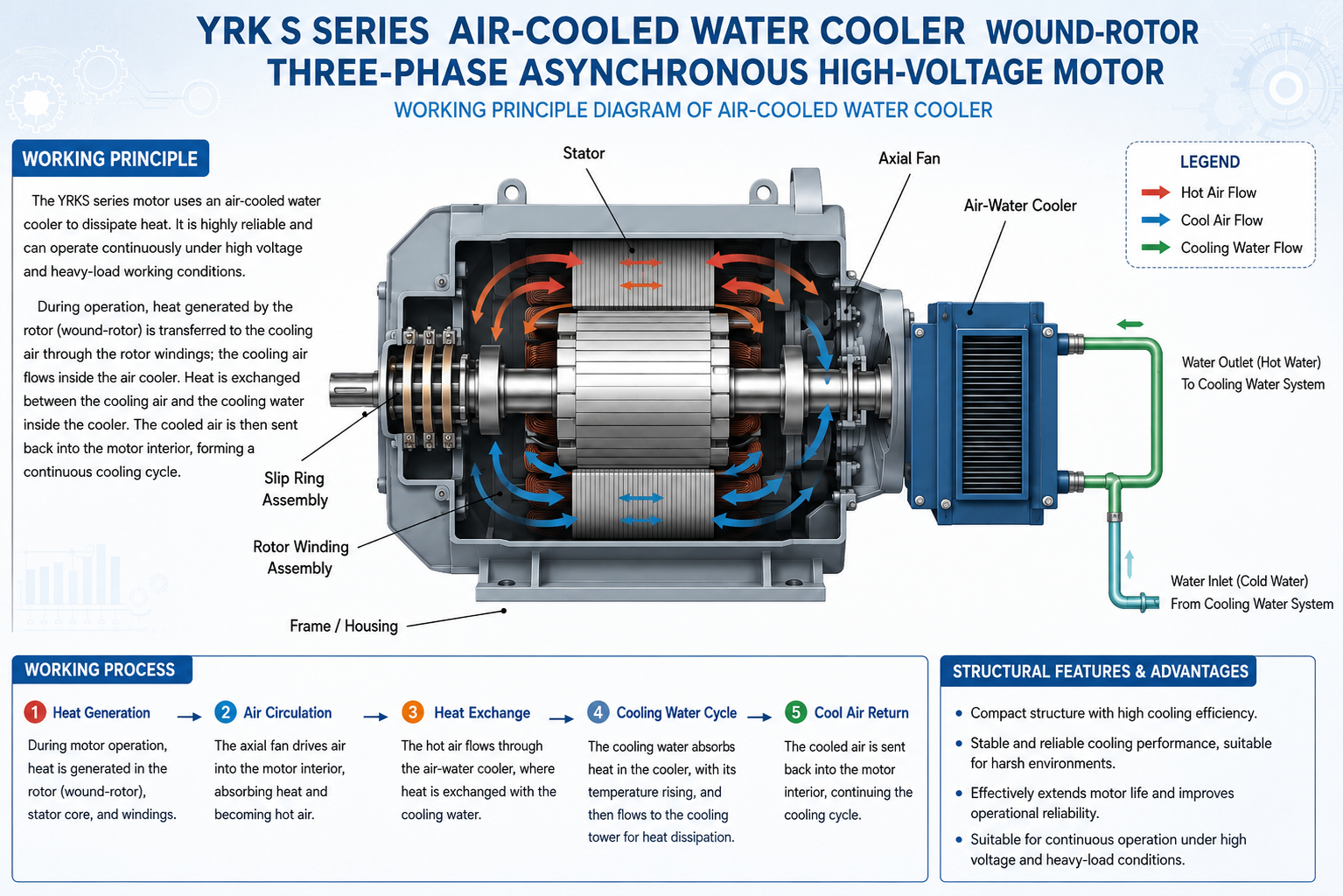
3. Inherent Disadvantages of YRKS
(1) Extra maintenance workload from wound rotor structure (vs all squirrel-cage YKS/YKK/Y)
- Equipped with slip ring and brush chamber: carbon brushes wear out and require regular inspection & replacement; slip rings oxidize and accumulate carbon powder, triggering sparking and poor rotor circuit contact without routine cleaning.
- Additional matching startup rheostat / speed control cabinet and rotor cables raise system complexity and total auxiliary investment.
(2) Mandatory stable cooling water supply (vs air-cooled YRKK & open YR)
- Dedicated circulating water system required: cooling tank, water pump, pipelines, valves and water treatment unit; not applicable to sites without clean steady water supply or open field installations.
- Heat exchanger risks: poor water quality causes limescale clogging leading to overtemperature; pipeline leakage may seep into motor casing and trigger winding short circuit.
- Auxiliary power consumption from running cooling water pumps; pipeline heat tracing needed to prevent freezing in low winter temperatures.
(3) Higher upfront procurement & civil engineering cost
- Same power comparison: 15%
25% more expensive than air-cooled wound rotor YRKK; 20%35% costlier than squirrel-cage air-water YKS; over 40% higher price than IP23 open YR. - Extra civil construction budget reserved for water piping, drainage and cooling station layout.
(4) Complex structure with more potential fault points
Troubleshooting covers heat exchangers, water valves, carbon brushes, slip rings and rotor speed control loops; maintenance procedures take longer than air-cooled or open-type motors.
4. Horizontal Comparison with Peer Motor Models
YRKS vs YRKK (Same wound rotor, air-water cooling VS air-air cooling)
| Item | YRKS (Air-to-Water Cooled) | YRKK (Air-to-Air Cooled) |
|---|---|---|
| Heat Dissipation | Outstanding, supports high power & high ambient temp | Moderate, must derate under high temperature |
| Noise Level | Low, no external cooling fan | Higher, continuous noise from dual air duct fans |
| Auxiliary Matching | Complete circulating water system required, high civil cost | Only ventilation needed, simple installation |
| Maintenance | Dual upkeep for carbon brushes + water circuit, risk of scaling & leakage | Only brush maintenance, no water-related failures |
| Application Scenarios | High-power indoor workshops with 24/7 full load & cooling water available | Medium-small power plants with ventilation, insufficient water supply |
YRKS vs YKS (Same air-water cooling, wound rotor VS squirrel cage)
| Item | YRKS | YKS |
|---|---|---|
| Startup Performance | Soft startup with minor grid impact, adjustable speed | High direct-on-line current, speed regulation only via inverter |
| Maintenance | Periodic brush replacement, complex auxiliary system | Brush-free, minimal maintenance |
| Total Cost | Higher motor + control cabinet investment | Lower unit price, simple supporting system |
| Suitable Loads | Heavy machinery with frequent startup & large inertia | Stable continuous loads (water pumps, standard fans) |
YRKS vs Open IP23 YR
| Item | YRKS | Open IP23 YR |
|---|---|---|
| Protection Grade | IP54 fully sealed, dust & moisture resistant | IP23 vented, dust & moisture directly invade windings |
| Service Life | Long insulation lifespan, durable in harsh environments | Frequent short circuits in dusty sites, frequent overhauls |
| Footprint | Smaller frame at equal power | Larger frame size, weaker heat dissipation |
| Site Adaptability | Perfect for enclosed workshops | Clean ventilated plants only, prone to overheating in closed rooms |
5. Recommended & Non-Recommended Application Scenarios
Preferred for YRKS
- Mine ball mills, mine hoists, metallurgical rolling mills, heavy crushers (heavy frequent startup, limited grid capacity)
- High-power compressors & coal pulverizers in power / chemical enclosed plants (high temperature, heavy dust, round-the-clock operation)
- Indoor factories with circulating cooling water system & strict low-noise requirements
- High-altitude areas or summer ambient temperature above 35°C where air-cooled motors fail heat dissipation demands
Not Recommended for YRKS
- Sites without stable cooling water, open-air field locations or extremely high water supply cost (select air-cooled wound rotor YRKK instead)
- Light stable continuous loads with tight budget (choose squirrel-cage air-water YKS)
- Facilities lacking maintenance staff for regular brush & water circuit inspection (prioritize brushless air-cooled YKK)
- Units ≤315kW with low cost efficiency; YRKK fully meets performance demands
6. Selection Summary
- Core competitive strengths: soft startup of wound rotor + ultra-efficient air-to-water cooling, optimal solution for high-power heavy-load harsh industrial environments
- Key drawbacks: reliance on dedicated cooling water system, regular brush maintenance, high initial capital expenditure for host & auxiliary facilities
- Selection rule of thumb: Pick YRKS if you have steady cooling water, heavy loads, high power and enclosed hot workshops; choose YRKK/YKS if water access is limited, power rating is medium-small or maintenance manpower is insufficient.
Related Posts

NORD UNIVERSAL SMI Worm Gearmotor (Low Voltage)
Jua 27, 2026
NORD MAXXDRIVE® Parallel Gear Unit (Standard Model)
Jua 26, 2026
SIEMENS Industrial Low-Voltage Helical Gearmotor
Jua 26, 2026