











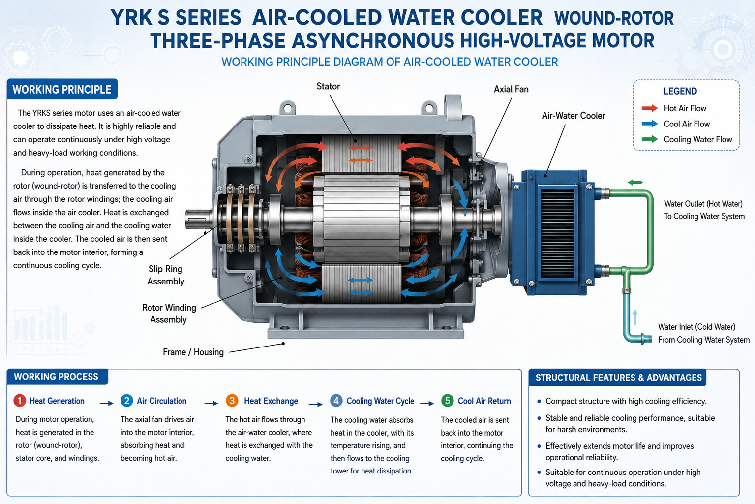
Working Principle of YRKS Series High Voltage Wound Rotor Motor with Air-to-Water Cooler (IC81W)
Working Principle of YRKS Series High Voltage Wound Rotor Motor with Air-to-Water Cooler (IC81W)
SEO Core Keywords Embedded:
YRKS high voltage motor, wound rotor slip ring motor, IC81W air-water cooling, medium voltage induction motor, closed air circulation heat exchanger, industrial heavy-duty motor, high power slip ring motor
1. Product & Cooling Type Definition
YRKS series is a box-type fully enclosed high voltage wound rotor slip ring 3-phase induction motor, marked with standard cooling code IC81W air-to-water cooling system. It adopts two independent closed heat circulation loops: internal primary air circuit and external secondary water circuit, completely isolating internal motor air from ambient workshop air. The IP44/IP54 protection grade enables stable operation in mining, metallurgy, cement, chemical and other dusty, humid, corrosive heavy industrial sites.
2. Main Structural Components
- High voltage motor main body: stator core & winding, wound rotor assembly, slip ring chamber, coaxial built-in circulation fan
- Top-mounted air-to-water heat exchanger (core cooling unit): finned copper/stainless steel cooling tubes, upper & lower air plenum, flow guide baffles, condensate drain tray, drain valve
- Water circulation auxiliary system: inlet/outlet pipelines, circulating water pump, cooling tower/water tank, water filter, flow pressure interlock protection switch
- Internal air flow channel: upper frame air duct, stator radial ventilation slots, rotor axial ventilation passages
3. Dual Closed Circulation Heat Dissipation Process
Loop 1: Closed Primary Air Circulation (Heat Absorption Inside High Voltage Motor)
During motor operation, copper loss and iron loss of stator windings, rotor bars and iron core continuously generate massive heat. The coaxial built-in fan drives internal air to circulate in a fully sealed loop:
- Cool internal air flows through stator and rotor ventilation grooves, absorbing heat from high voltage windings and iron core to become hot air;
- Hot air rises along the upper frame air duct and enters the top air-water heat exchanger cavity;
- Hot air transversely scours the outer fin surface of cooling tubes, transferring heat to cooling water flowing inside tubes via forced convection;
- Cooled low-temperature air flows out from the bottom of the heat exchanger, returns to the air gap between stator and rotor through the lower air duct, and repeats the heat absorption cycle.
Key feature: The primary air loop never communicates with external ambient air, preventing dust, moisture and corrosive gas from invading high voltage insulation, greatly extending service life of motor windings and slip ring components.
Loop 2: Secondary Water Circulation (External Heat Discharge)
Cooling water serves as the secondary heat transfer medium to carry away heat absorbed from internal motor air:
- Low-temperature cooling water flows into heat exchanger tube bundles from the water inlet, absorbing heat conducted by tube walls and rising in temperature;
- Warm water flows out from the water outlet and circulates back to outdoor cooling tower or circulating water tank;
- Cooling equipment dissipates water heat into atmosphere, and chilled water is pumped back to the air-water cooler to form continuous water circulation;
- Equipped with water cut-off & low-pressure interlock protection: the control system triggers alarm or emergency stop once water flow is interrupted, avoiding overheating burnout of high voltage motor windings.
4. Heat Transfer Physical Mechanism
Two-stage heat transfer combination of forced convection and solid heat conduction:
- Hot internal air → heat exchanger fins & tube walls: air-side forced convection heat exchange;
- Tube wall metal → internal cooling water: solid heat conduction + water-side forced convection.
Water has far higher specific heat capacity than air, so air-water cooling delivers 3–5 times higher heat dissipation efficiency than air-air cooling (YRKK series), supporting higher power density on the same motor frame size.
5. Condensate Anti-Shortage Design
Temperature difference between hot internal air and cold tube walls will produce condensate inside the heat exchanger. An inclined drain tray and external drain pipe are installed at the bottom of the cooler to automatically collect and discharge condensed water, avoiding water dripping onto high voltage windings and slip rings which causes insulation breakdown, creepage and short circuit faults.
6. Core Advantages of YRKS IC81W Air-Water Cooled High Voltage Slip Ring Motor
- Higher heat dissipation capacity: suitable for heavy-load continuous running high power high voltage wound rotor motors;
- Ultra-low running noise: no large external cooling fan compared with air-air cooled YRKK motors;
- Compact layout: smaller installation footprint, ideal for closed workshops with poor ventilation;
- Superior environmental adaptability: fully sealed internal air circuit, fit for high-dust, high-humidity, corrosive industrial environments;
- Stable temperature control: uniform winding temperature, reducing thermal fatigue and prolonging high voltage motor service life.
7. Standard Operation Technical Requirements
- Inlet cooling water temperature ≤33℃, temperature difference between inlet & outlet ≤10℃
- Inlet water pressure range: 0.1~0.3MPa
- Cooling water needs softening & filtration to prevent tube scaling and blockage
- Water flow interlock protection must be configured; long-time operation without cooling water is prohibited
Short Version (For Product List Page / Sidebar Introduction)
Working Principle of YRKS IC81W Air-to-Water Cooled High Voltage Wound Rotor Motor
This heavy-duty slip ring high voltage induction motor adopts dual closed circulation cooling design. The built-in fan circulates sealed internal air to absorb heat from stator and rotor windings, then hot air exchanges heat with cooling water inside the top air-water heat exchanger. The heated water circulates to an external cooling tower for heat dissipation, while cooled air recirculates back into the motor. Separated air & water loops fully isolate internal insulation from ambient dust and moisture, delivering efficient, low-noise and reliable cooling for high power industrial high voltage motors under harsh working conditions.
High Frequency SEO Keyword List (For Meta Title & Description)
YRKS high voltage wound rotor motor, IC81W air-water cooling motor, slip ring induction motor, medium voltage air-to-water heat exchanger motor, heavy industry high power motor, closed circuit cooling motor, mining cement drive motor
Related Posts

NORD UNIVERSAL SMI Worm Gearmotor (Low Voltage)
Jua 27, 2026
NORD MAXXDRIVE® Parallel Gear Unit (Standard Model)
Jua 26, 2026
SIEMENS Industrial Low-Voltage Helical Gearmotor
Jua 26, 2026